


Year-end tax planning in November is already late. Here's what you can still do
By: Jay Parks

The best tax planning usually happens in spring and summer, when there's time to adjust paychecks and shift income without a deadline looming. By mid-November, a lot of those windows have narrowed. Payroll departments need lead time, brokerages and charities get slammed in late December, and the holidays take a bite out of the seven weeks left in the year.
That's the bad news. The good news is that plenty of moves still count for 2026 if you act soon, and a few of the most useful ones stay open until April 15, 2027. If you're doing year-end tax planning in Edmond this month, here's how to sort what's urgent from what can wait.
Moves that close on December 31
These must be completed by the last day of the year to count toward 2026. Several depend on someone else's processing time, so the earlier, the better.
Bump up your 401(k) or 403(b) deferrals
Workplace retirement contributions must come out of a 2026 paycheck to count toward 2026. This year you can defer up to $24,500, plus an $8,000 catch-up if you're 50 or older. If you're 60 to 63, the catch-up is $11,250 instead. Payroll changes can take a cycle or two, so call HR this week rather than the week before Christmas.
Take your required minimum distribution
If you're required to take an RMD from an IRA or old workplace plan, the deadline is December 31. A missed RMD can trigger a 25% excise tax on the amount you should have taken, reduced to 10% if you correct it promptly. Your first RMD can wait until April 1 of next year, but then you'll take two distributions in the same tax year.
Give from your IRA instead of your checkbook
If you're 70½ or older, a qualified charitable distribution lets you send up to $111,000 straight from your IRA to a charity in 2026. The gift counts toward your RMD and stays out of your taxable income. The money has to go directly from the custodian to the charity, and donor-advised funds don't qualify, so start the paperwork now.
Rethink charitable giving under the 2026 rules
Charitable deductions work differently starting this year. If you take the standard deduction, you can now deduct up to $1,000 of cash gifts, or $2,000 if you're married filing jointly. Gifts to donor-advised funds and private foundations don't count toward that deduction.
If you itemize, only giving above 0.5% of your adjusted gross income is deductible. On $150,000 of AGI, the first $750 of gifts produces no deduction. Taxpayers in the top bracket also benefit from itemized deductions capped at 35%. Gifts must be made by December 31, and a check counts on the date it is mailed.
Harvest investment losses
If investments in a taxable account are worth less than you paid, selling before year-end can offset gains you've already taken, plus up to $3,000 of ordinary income. Watch the wash sale rule: buying the same or a substantially identical investment within 30 days before or after the sale disallows the loss.
Consider a Roth conversion
A conversion from a traditional IRA to a Roth IRA is treated as completed in the year it occurs, so a 2026 conversion must be completed by December 31. It adds to this year's taxable income, which makes it worth running the numbers first. It can make the most sense in a year when your income dipped.
Make annual gifts
In 2026, you can give up to $19,000 to any one person without filing a gift tax return, and your spouse can do the same. The annual exclusion doesn't carry over, so unused 2026 room disappears on January 1.
Business owners: equipment and timing
Equipment generally has to be placed in service, not just ordered, by December 31 to be depreciated on your 2026 return. Cash-basis businesses may also have room to time when they send invoices and pay expenses. Both are worth a conversation before you buy anything just for the deduction.
Moves that can wait until 2027
These still count for 2026, but you have more breathing room. Put them on your list for January rather than crowding them into December.
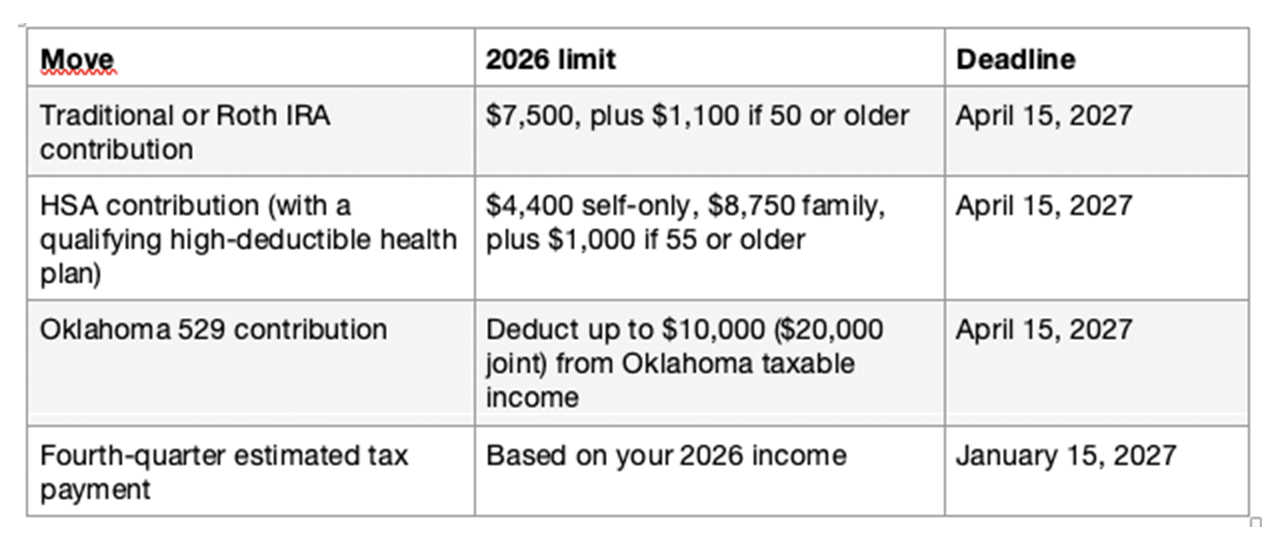
Whether an IRA contribution is deductible depends on your income and whether a workplace plan covers you. Oklahoma 529 contributions exceeding the annual deduction limit can be carried forward for up to 5 years.
A few notes for Edmond households
Oklahoma's rate cut is already here
Starting with tax year 2026, Oklahoma lowered its top income tax rate from 4.75% to 4.5% and simplified its brackets. Any further cuts are tied to state revenue triggers, so don't push income into 2027 counting on another rate drop.
The bigger SALT cap may change whether you itemize
The federal cap on state and local tax deductions rose to $40,400 for 2026. It phases down for modified AGI above $505,000. Add Oklahoma income tax and property taxes on an Edmond home to your mortgage interest, and some households that took the standard deduction for years may now come out ahead itemizing. That changes which charitable rules apply to you, so check before you give.
Retirees 65 and older get an extra deduction
From 2025 through 2028, taxpayers 65 and older can claim an additional $6,000 federal deduction per person, whether or not they itemize. It phases out above $75,000 of AGI for single filers and $150,000 for joint filers, which makes the timing of IRA withdrawals and Roth conversions worth a closer look.
Where to start this week
If you only do one thing, pull your most recent pay stub and your latest brokerage statement. Those two documents answer most of the questions above. If you'd like a second set of eyes before December 31, our office is glad to walk you through your situation.